
This Story was written by H.P. Schwab, who took part in the salvage and now has retired from ABC Maritime, Nyon. Many thanks go to Capt. Saliou Diouf, who checked the story and has made some important corrections
In the night from Saturday to Sunday the AFRICAN STAR 2, under command of Capt. Saliou Diouf, was on her way from Malongo to Libreville, loaded with 5 empty containers and some general cargo, including some core samples. In the morning hours of 10.08.1997 at about 04:30 a Dutch radio station called Panalpina in Port Gentil and alerted them, that a distress call (SOS) was picked up at midnight from the AFRICAN STAR 2, the position given was 02° 34' S / 009° 47' E, about 120 nautical miles south of Port Gentil, near Sette Cama, no any further details were available. Panalpina raised the alarm in Port Gentil and to the office of ABC Maritime, in Nyon, causing first a big confusion, as nobody knew what exactly happened to the boat – was she drifting, had she sunk, what really happened? The JAVLIN TIDE of Tidewater also received the distress call. Our small supply vessel THEO (1520 BHP), laying idle at anchor in Port Gentil, received a message from Panalpina's MERLIN II, her captain had spoken on the VHF to Captain Diouf on the AFRICAN STAR 2 and confirmed, that the boat was beached.
In the morning, Frans Jacobs of Panalpina chartered a helicopter from the Aero Club and could spot the boat on the beach south of Sette Cama. They landed on the beach and Frans talked to the captain and the crew. The first mate Ousseynou, who was injured on his foot, was taken back to Port Gentil. The THEO under command of Capt. Bernard (Bob) Dubois and with Chief engineer Jean Lohou (Chef Jean) was dispatched south and anchored on the accident site, about 850 m from shore in only 4,8 m water depth.
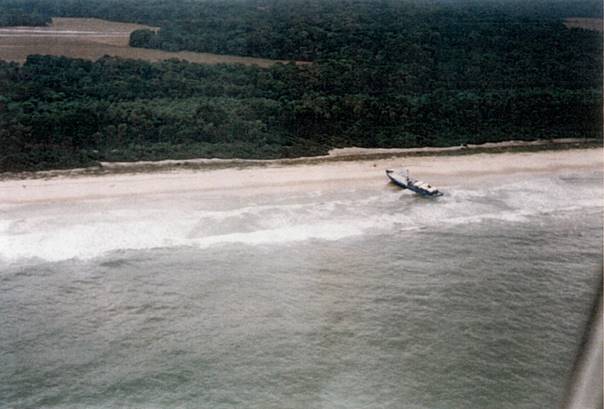
The AFRICAN STAR 2 started to suffer from vibration problems with her propeller arrangement already soon after delivery. As usual, the first bad news came in on Friday 30.08.1996 at noon time, when she sailed southbound from Malabo to Port Gentil. The captain sent a distress message, reporting irregularities with main engine No. 5 (STB outboard) and water ingress in the steering gear room. The water could be stopped by the crew and the boat reached Port Gentil safely. Of course my weekend was spent travelling on Saturday morning down to Gabon to assess what had happened. On Sunday the vessel was taken up the slip at DPS, Delmas Petroleum Services to inspect the damage. The strut had broken off and the long, slim, still running tail shaft deflected upwards, with the propeller cutting a big gash into the bottom of the steering gear room. The propeller shafting was removed and the damaged hull plate covered with a doubler plate. The AFRICAN STAR 2 now continued her service on four engines until a new strut, tail-shaft and propeller was delivered from the USA and installed in May 1997 in the floating dock in Douala.
While awkward negotiations with the builder's yard, meanwhile in financial difficulties, still went on, the next, more serious incident commenced to develop in August 1997. On a beautiful Sunday morning, enjoying an apero with friends, got a phone call from Hans Tanner, chairman of the company, telling me, the AFRICAN STAR 2 had disappeared and does not answer any radio messages, he asked me to go to Port Gentil as quick as possible. Sunday afternoon was spent to make the necessary travel arrangements and to gather some few information about the boat.
On AFRICAN STAR 2 on Saturday evening at dusk, the Chief engineer Stefan Lautenbach observed abnormal noise coming from engine No. 2 (PS inboard), which was slowed down and then stopped. The noise emanated from the FW-tank PS and after opening the tank, distortion on the bottom and a crack was noted in way of the strut of tail shaft No. 2. The freshwater at the bottom of the tank already was brackish. Around midnight, the high bilge alarm from the engine room sounded in the wheelhouse and alerted the crew and Stefan found sea water sloshing around in the bilge. The water entering in way of stern tube No 2, through a cut of about 60 cm long and 2-5 cm wide, ground open by the trailing and deflected shaft. It was impossible to plug the hole against the water pressure. Despite all efforts, the fight against the water ingress was lost, the boat taking a big list to port and the water kept rising incessantly in the engine room.
To prevent her from sinking, the master decided after a short discussion with his officers to beach the vessel on the sandy beach along the coast of Gabon. At about two in the morning the vessel touched ground and the hull was smashed violently many times against the sandy bottom by waves more than three meters high. The master sent out a distress message and tried via the SSB to alert any ships in the vicinity, but no response was received. The diesel generator blacked out and then only the thundering noise of the waves breaking on the beach could be heard. Fortunately no any gas oil or lube oil was spilled onto the beach.
As revealed the next morning, they actually were very lucky, about 5 or 6 meters more to port, the boat would have hit an old mooring buoy, which was buried in the sand, protruding only for about 30 cm from the sand, but enough to tear open the hull. The boat was beached approximately ten kilometres south of Sette Cama, an old anchorage at the northern end of lagoon Ndogo, used in the colonial days to load logs. The buoy probably was dislodged and drifted away, ending up on the beach. The densely forested area is now a nature reserve, famous for the elephants, coming at night right down to the sea side.
On Monday evening I arrived in Port Gentil, the next morning commenced to put the few available bits and pieces together and look around in the town for any salvage possibilities. The next day took off with a chartered Beechcraft aeroplane and a so-called French "salvage expert" to overfly the accident site and to deliver a small portable generator and some other, urgently needed material to Gamba. This stuff was delivered from the airfield to the vessel by a Land Rover of our shipyard/mechanical engineers SEMTS in Port Gentil (SEMTS had a workshop in Gamba, working on the onshore oil fields of Shell). Fortunately, the local "salvage expert" was not contracted, probably the whole exercise would have ended in a great disaster for us.
Instead, Thursday morning Werner Häni arrived, a Swiss civil engineer and diver, working mainly in the oil fields in Nigeria. We spent the day on a shopping tour, buying only light, easy to handle material, including a small motor-pump and polyurethane foam in spray cans (as used for insulation etc. in the building industry). Finally the big moment dawned, it was now already Friday, Werner and myself, together with Gregory, a local diver from Comex, we left Port Gentil in the same Beechcraft to fly down to Gamba. With two cars, a Toyota pick-up and a Toyota Landcruiser and three workers from SEMTS, we drove on a sandy track through the savannah and the forests to Sette Cama. Nothing of any value could be found in the small village, not even a bush bar. But we paid a curtesy visit to the village boss. To obtain his good-will we had to drink a few beers with him and his friends, after about two hours of palaver we left for the AFRICAN STAR 2. The workers showed us a hidden passage through the forest and the last few kilometres we drove along the beach.

We found the crew camping on the beach, around a small fire. Food was prepared on this fire, whatever was possible, but no 7-course menu on the plan. The temperature in the freezer boxes slowly raised and eventually Saliou ordered to pre-cook some of the meat to prevent it from deteriorating too fast. At one stage, Werner purchased a large fish in the village. Fresh water was available from the fore peak, but had to be collected by bucket, also bottled water was plenty on board. Most of the men slept during the night on board in the upper saloon, one man kept watch on shore. The fire was maintained all night, first it was terribly cold on the wind-swept beach, secondly everybody was afraid about the elephants. Nobody had seen a roaming elephant, but the proof of their existence could be found close enough on the beach, large balls of dung lying in the sand. The spray from the crashing waves covered the entire shore line with a mist, making the beach a ghastly and eerie place in the darkness.
The captain had rigged a mooring line from the starboard bow onto a tree to prevent the hull from veering to port onto the old buoy and possibly holing the fuel tank, spilling the gas oil onto the beach. The radio batteries were preserved and only used to load-up the walkie-talkies to maintain communication with the THEO. The engine room and the steering gear were flooded, with oil floating on top, but the accommodations were still dry. The tide and the swell kept the sea water surging in and out through the cracks and holes in the hull. We commenced first to build a cement-box over the cut on the stern tube to prevent the engine room being filled with sand. This was a very dirty and awful task for our two divers to grabble around in the dark and murky water. Some tools were retrieved from the oily water of the engine room and the steering gear compartment, sea valves, air vents and air intakes were closed. At low tide the exhaust pipes were plugged from the outside. Werner and Gregory searched for leaks and could plug some of them, using the foam.
On the first glance, the area seemed to be completely deserted, but some odd visitors arrived on the scene. The first one to pay us a visit, was the game warden of the WWF, later an elderly Italian engineer passed by, hunting exotic butterflies. Then a fairly attractive English lady showed up, pretending to study the life of the large monkeys in the forest.
On Sunday afternoon we returned to Port Gentil to get some more needed material and some provisions. A new portable diesel generator had to be obtained, as the first one packed-up on the first day. Of course Monday was a public holiday and no shops were open, we were "forced" to relax. Therefore it was already Wednesday, when we returned back again. On the way to the vessel, our car sunk into the mud twice and now we had first to "salvage" our car and get it out again, delaying us by about 3 hours.
After our arrival, the zodiac of the THEO came towards the shore and set a small yellow marker buoy just outside the line, where the waves started to break, then it came to the shore to pick-up myself, apparently Hans Tanner wanted to talk to me on the radio. The swell was quite high now and Werner advised not to go. Anyway, off we went and the sailor on the out-boarder slowed down, instead to give full power. The wave built itself up to a dreadful height, began to break above us and overturned the zodiac. We were hurled out into the water. The next thing, I could see, the zodiac above myself with the engine about to crash down. After an awful long time under the water, came free again and could walk on shore. The two sailors also reached the beach unblessed and remained on shore. Stefan got the portable generator going and for the first time after ten days, there was light in the accommodations. Werner and myself wanted to drive to the village to buy some fish, but twice the car almost got stuck in the sand. We returned and lucky enough, we could get hold of the last two cans of beer (then, beer was still allowed, good old times). Sitting on one of the washed-up logs we drank the beer – incidentally it was Werner's 50th. anniversary.
During the night the swell increased and the hull slammed with frightful noise against the ground. To stabilize the hull, the engine room was filled with water. Next morning, we got the SSB and the satcom-C back into service. Now only remained to connect both vessels for towing, using all our mooring ropes. The marker buoy set by THEO earlier on, was torn off and drifted away during the night. The THEO came in close again and twice they tried to shoot a line with the line thrower, but both attempts failed. Then they built a small raft with the tow line on it and let it drift towards the shore. Meanwhile Gregory, a strong man, swam through the breaking waves and attached a heaving line to the tow line and returned back safely.
In the small hours of Friday 22.08.1997 commenced to pump out the water in the engine room and at high tide, still dark and shivering cold, the THEO started to pull with half engine power, thereby always keeping the line taut. During the morning the AFRICAN STAR 2 moved almost imperceptible, towards the sea. At 07:40 some short excitement, the port bridle broke, which was attached to the stern. Now Saliou changed the arrangement and fastened the towing line and its bridle to the bow. The same time he asked the master of the THEO to pull more in a southwest direction. All the morning the THEO kept pulling gently, at low tide she was already about 50 m further down towards the sea and laying parallel to the beach.
At noon the WWF-guys came along the beach on their way to Gamba to see how we were doing. Werner went with them in his car to buy some additional petrol for the moto-pump. The THEO always kept pulling to prevent the boat from being driven back onto the beach. With the next tide rising again she moved slowly towards the sea und about 16:30 she pointed seawards and suddenly jumped forward, we were floating again. This day was also the birthday of Saliou – A very special birthday present for the captain, his vessel was back in the deep water and floating again.
At same time, Werner arrived with a few jerrians of fuel, but we were already too far away. Quick-witted, Saliou took a line throwing apparatus and we could pull the cans on board. Werner and one sailor were left behind, they drove along the beach towards Gamba. In the mouth of a small river, the car got stuck in the sand and could not be recovered. The next high tide buried the car in the sand. The last miles to Gamba they had to do on feet. The people of SEMTS were furious, not because of the money lost (which was reimbursed anyway), but replacement of the much needed car took a terrible long time.
Initially, after floating free, the AFRICAN STAR 2 had a list of about 10 degrees to port and her stern was deep in the water, but after further pumping of the engine room, the steering gear and the fresh water tanks the situation improved considerably. The trip to Port Gentil was without any major problems, but we had to be on a constant alert. Our motor pump was running most of the time, constantly draining entering water from the engine room and the steering gear compartment. Gregory dived below the hull and found some more leaks, which he could plug with the foam. All the time we continued at approximately 5,3 knots. The next day shortly before midnight we arrived in Port Gentil and the boat was moored at the fishery pier. The Frenchmen in Port Gentil were gossiping and wondered how the Swiss brought the boat so quickly back into the safety of the harbour without any "salvage expert".
Sunday morning all the cargo was discharged and on Monday we transferred the gasoil onto THEO. Werner dived again under the boat and closed a few small leaks with foam. The next day shifted to SEMTS, established shore power for the accommodation and the shipyard workers started to wash out engine room. Finally on 02.09.1997 the slipway at SEMTS was free and the boat put up for inspection. All the propellers and rudders were completely bent and destroyed and had to be removed. All holes were closed by welded doubler plates and the boat prepared for ocean towing.
Again, we were lucky, Panalpina announced on a Friday afternoon in October, a Danish tug had arrived in the harbour and the master was looking for a tow to go back north. Subsequently, within about 3 or 4 days, arrangements were finalized to tow the AFRICAN STAR 2 back to France. The Danish tug VLIELAND (GT: 69/Year of built 1970) towed her to the Canary Islands, where another tug, the Danish STORESUND took over at sea and towed her, now stern first, to St. Nazaire, France. Approaching Cabo San Vincente, the southern tip of Portugal, a severe storm forced the tow to take refuge for several days in the harbour of Portimao. The tow arrived on 17.11.1997 in St. Nazaire and was put alongside the shipyard OCEA, a company specialising in aluminium vessels (the main office and main shipyard of OCEA are in Le Sable d'Olonne).
The boat was put in one of the small public graving docks near the shipyard. The whole machinery and electrical equipment was taken out from the engine room. Together with Bureau Veritas OCEA designed a completely new strut arrangement, using solid aluminium blocks. All main engines and diesel generators were replaced by new ones, electrical cables and equipment renewed. The buckled plates in way of the fuel tank port were renewed. Further the exhaust gas arrangement was changed from a wet exhaust to a dry system.
In the morning of 31.03.1998 the AFRICAN STAR 2 sailed back to West Africa via Dakar to resume her service. Along the Portugese coast she was hit by a severe storm, but further down she had smooth sailing. Since then, the vessel operated without any further problems and to the satisfaction of everybody concerned. Remains to note, during the almost eight months out of service, the OBANDO MARINER from Port Gentil carried out the African Star Service of Panalpina. Ousseynou sailed most of the time as supercargo with her to ensure correct distribution of the cargo.
SwissShips HPS, April 2018
The propeller struts
The design of the propeller struts was in principle a well-proven, simple construction, as applied probably to hundreds of work boats built in the USA. Below shows a tail shaft tube with the strut, however almost turned downwards by 180 degrees.
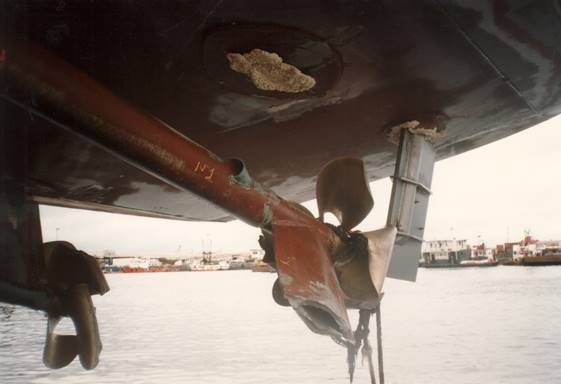
Basically, two plates are bent and welded against each other, as shown in the next photograph below.
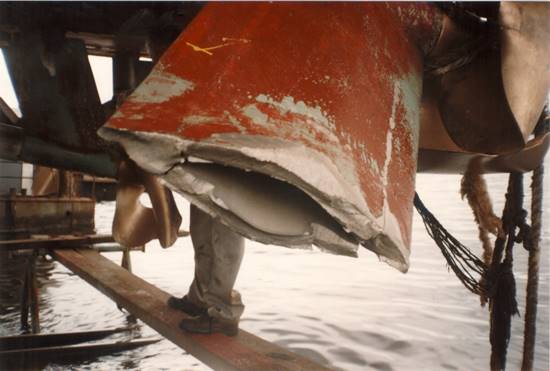
The old AFRICAN STAR had the same arrangement, which never gave any problems. However with five propellers, vibration were induced, leading to the struts breaking off at the hull penetration. Apparently a very similar boat in the Fareast and built by the same shipyard suffered from the same problems. The French shipyard designed a new strut, fabricated from a solid block of aluminium, in this way the problem was solved.
SwissShips HPS, April 2018
