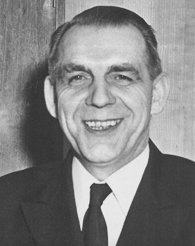
Captain Alfred Peter WEICHLEIN and the M/S BREGAGLIA
“Pacha” is the respectful term given in French to the captain of a ship, based on the title held by the Grand Admiral of the Ottoman fleet between 1401 and 1867. I had the pleasure of sailing for more than three years with this Pasha, who did not talk much about his carrer. When filling out the numerous and repetitive crew lists that I had to complete during my brief career as an officer, I noted that he was born in Hassloch/Palatinate in 1915, information that remained deeply engraved in my memory. I also knew that Captain Weichlein had first served on various submarines during World War II. (U 74 - U 218 - U 264 - U 542). His name and various voyages can be found on websites dedicated to German submarines from the last war (u-bootarchive.de). But he never spoke to me in detail about this period of his life, except to tell me one day, as we were sailing in the tricky waters of the Øresund, Kattegat and Skagerrak, that he knew all these waters pretty well, both above and below the surface. He had also called at bases in France (St-Nazaire, Lorient) where he had discovered and tasted a great Bordeaux wine, the “Entre-deux-Mer”. That's why we had that delicious wine on board, for special occasions! Subsequently, his name appeared on numerous ships of various types, including German, Swedish, Greek and other oil tankers, in various positions within the hierarchy. In 1956, he took his first command. In early 1962, he was on his first Swiss vessel, the general cargo ship “Allobrogia”, owned by TMSO (Transports Maritimes Suisse-Outremer SA of Geneva, a wholly-owned subsidiary of Banque Pictet, Geneva). Then, in 1963, he was on the prestigious Ariana, a ship on which my cousin had the honour of sailing under the command of Captain Weichlein. The Ariana was also managed by Suisse-Outremer SA. In mid-1965, Alfred Weichlein took command of the M/S BREGAGLIA, where I met him. This bulk carrier became “his ship” and he remained there until the end of 1972, when the vessel was sold to a Chinese company. He then commanded ships belonging to the company as replacements on the „Corviglia“, „General Guisan“, “Silvretta”, “Lavaux” and “Silvaplana” until 1981, when he finally retired at the age of 66.
With Captain Weichlein, I had the opportunity to visit every continent and almost every sea and ocean on the globe during those years at sea. Careless naval architects began designing flat-bottomed barges, confusing centre of gravity and hydrostatic thrust centre. The aim was to double the load for the same draught, i.e. 18,000 tonnes over eight metres; The BREGAGLIA was built in 1962 at the “3. Maj” shipyard in Rijeka, Yugoslavia. The design work was entrusted to the naval architecture firm “Maier Form”, a company with a good reputation that has built more than one ship. It seems that they were asked to create a “five-legged sheep”, and the result is the one so well described by J.-P. Vuillomenet above. Unlike other cargo ships, the BREGAGLIA does not meet Lloyd's (British) standards, but those of Bureau Véritas (French). This is a form of ship certification, and it is well known that acceptance criteria vary between classification societies. Maier Form probably had to work with Bureau Veritas, or perhaps the latter was more lenient; I never tried to find out, but the fact remains that these sister ships had a very bad reputation for stability and were known for their tendency to roll even in calm conditions. As you can see, the BREGAGLIA was a nasty roller, but I stayed on bord for more than three years. This just shows that this very ship must have had an attractive mystery about her, that I wasn't the only one to succumb to. The weather was awful and we were rolling crazily. The second steward brought us some drinks. The captain had clearly had a bad night's sleep and was in a foul mood; he greets the steward with a grumpy expression. Then, there was a terrible roll and both the captain and the steward lost their equilibrium and fell to the floor, sliding across all the width of the bridge on their backsides. As a result: the steward crashes first, against the door leading to the wing of the bridge; as for the captain, he ends up on top of the steward, probably mortified! I manage to hold on and I am the only one still standing. Taking the humorous side of the spectacle, I told the captain: On board the BREGAGLIA, Captain Weichlein had a feature that I have never seen on other ships: Our captain also liked to play music and had an electric piano in his cabin. From time to time, he would inform the crew that he was giving a concert, accompanied by a crate of beer from his personal reserve: a German beer called Beck's. He would play well-known tunes and invite us to sing along. We had some great evenings, and this excellent man clearly knew how to mingle with the crew while commanding the necessary respect. There were never any excesses during these parties. Captain Weichlein had also set up a competition in which participants bet on the date and time of arrival at the port of destination. They bet a handful of dollars, most of which went into a common pot, once the amount set aside for the lucky winner of the competition had been deducted. I never had the honour of winning, but with this “on-board fund” we organised many parties and bought Christmas presents, not to mention the wonderful Argentinean meat for the festivities. It was also aboard the BREGAGLIA that I met another extraordinary character: the famous ”rower of the impossible”, Roger Montandon. He would go on to row across the Atlantic... in a boat that I designed for him as a naval architect in 1982. We were already talking about this crossing, calling in Rio de Janeiro. All this was part of the kindness and fatherly side of Captain Weichlein, a remarkable sailor and a great man. P.-A. Reymond © December 2025
|