

The Kieler Howaldtswerke AG, Kiel, FRG (Federal Republic of Germany) received the order to build this ship from the Norwegian shipping company Leif Høegh & Co. Oslo, but during the construction work Deutsche Dampfschiffahrts-Gesellschaft "Hansa" Bremen bought the contract and had the freighter completed.
Launched on 30.12.1953 as HOHENFELS and put into service on 14.02.1954 for the "Hansa", Bremen under the flag of the FRG (home port Bremen, call sign DEDW). The HOHENFELS was the first ship of the shipping company "Hansa" to be fitted with air conditioning for the entire crew accommodations (note, the trading area of "Hansa" was the Persian Gulf, Pakistan, India).
In 1966, the ship was purchased by Companie de Navigation Transocéanique Suisse S.A., Genève, a company controlled by Keller Shipping AG, Basel. On 14.06.1966, the freighter was taken over by Keller Shipping in Genoa, renamed AROLLA and registered under the Swiss flag (call sign HBFC).
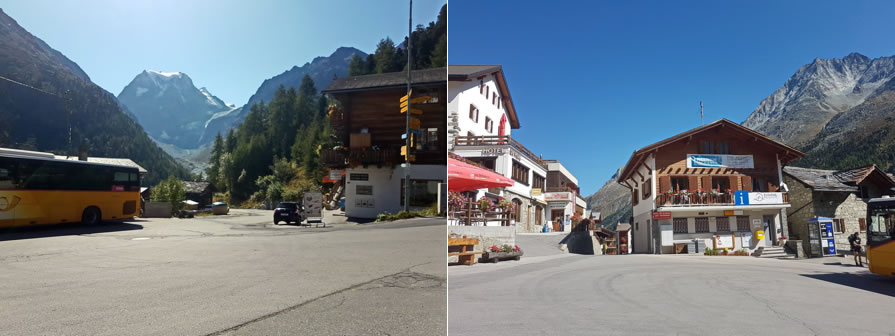
Arolla is a small mountain village in the French-speaking part of the canton of Valais, at the back of the Val d'Hérens and lies at an altitude of about 2000 m.
The AROLLA was now sailing in the liner service of the Nautilus Line from Italy to West Africa as far as Lobito in Angola.
On 25.03.1978, the shipping company laid up the vessel in the port of La Spezia and sold it to the demolition company Cantieri Navali del Golfo, which started the demolition work as early as 06.04.1978.
Additional Information and Stories
The AROLLA was a working ship, as Max Walser wrote in his diary "on this ship you can work as much as you want, when something is fixed again, something else is fucked straight away" (but more or less this was actually true for most Keller-ships, but also for ships of other shipping companies).
Many Swiss crew sailed on this ship, especially in the engineroom, obviously a completed technical apprenticeship paid off for the shipping company. Thus, with the various craftsmanship skills, many overhauls and repairs could be done by the crew themselves.
Unfortunately we do not have any crew lists from the AROLLA in our archives, although seamen known to us sailed aboard her in the 1960s. The chief engineer was Ernst Käch and Hans-Ruedi Fuchs (†2020) was Primo di Macchina (2nd. engineer). Rico Brönnimann (1st. electrician), Heinz Dürrenmatt (2nd. electrician) and Sämi Christen (1st. electrician †2014) sailed as electricians. On ships with electrical cargo winches, Keller Shipping always had two electricians on board, as in Africa loading and unloading normally took place around the clock. One electrician always had to stay on board and stand watch for the winches. Junior engineers were Heinz Kleinpeter (†2009) and Max Walser, later 4th. engineer. Gerhard Diener was "frigorista", responsible for the refrigeration machines. More names are added under "Diverse Photos".
On deck were Robert Sauter (†2021), Charly Bucher, boatswain and Kurt Russenberger, Chippy (carpenter), Ruedi Jasny, A.B., master was the Italian Renato Corsini.
Engine problems
The AROLLA had a double-acting, 6-cylinder crosshead diesel engine from MAN, built at the Howaldtswerke in Kiel, type: D6Z 72/120. Double-acting means that the underside of the piston was also used as a combustion chamber. A cylinder thus had 3 injectors, one large one at the top of the cylinder cover and two smaller injectors at the bottom, one injector on each side.
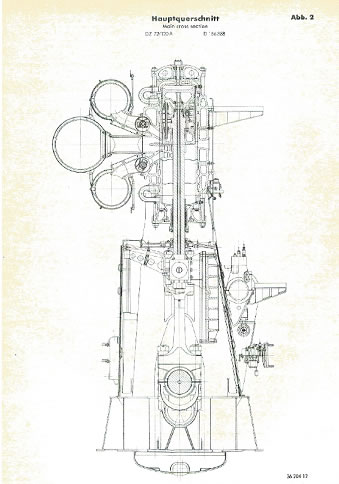
Cross-Section of the MAN-main engine
(Historisches Archiv MAN Augsburg)
One problem with this engine was the sealing of the piston rod against the high working pressure in the lower combustion chamber. The many injectors also required a great deal of maintenance. Initially, the engine suffered from poor combustion due to a lack of air. The writer noted, that AROLLA upon sailing from Genoa clouded the harbour and the Sampierdarena district under thick black smoke. Sparks were also flying from the funnel and fire hoses were laid out on deck as a precaution for rapid intervention. It took the resetting of the rotating exhaust valves set within the two exhaust pipes and the electricians overhauling the engine room fans (Direct Current) to bring them back to optimum power to correct this situation. From 1967 onwards, the engine was only run at a maximum of 100 rpm due to the engine block having a crack! Several attempts were made to weld the crack tight again, but this failed; it usually cracked again after a week. So the ship sailed with reduced revolutions, corresponding to approximately 5000 BHP.
Max Walser wrote in his notebook that the main engine revolution counter had reached a total of ten million revolutions on 27.06.1969 and went back to zero! Assuming an average of 105 rpm, this gives 1587 operating hours. Furthermore, if we assume that a general cargo vessel of that time was at sea for about 40 to 60 % of the time, the counter has already been set to zero many times (one year has 8760 hours). Consequently, if the freighter was half time at sea and half time in port, then the main engine and the propeller rotated about 414 million times in the 15 years.
When taking over the ship, the two aft cranes were out of order because they were "no longer repairable", but the electricians got them working again with a lot of patience. It had already started with the fact that consumable parts, such as V-belts were no longer available on board. The spare parts store was generally a problem, all filled with spare parts, only when you unpacked them from the oiled paper and freed them from the layer of grease most times a used or defective part appeared!
The AROLLA had cold storage rooms for cargo and also air conditioning for all crew quarters. The coolant used was ammonia (NH3), a pungent-smelling, poisonous gas, which, unlike freon, has no effect on the greenhouse effect (but that did not matter at the time). When searching for leaks, the "frigorista" had to protect himself with a mask. Today, ammonia is even being discussed again as a fuel for ships.
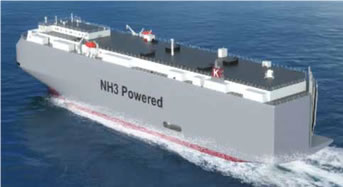
A project of the Japanese K-Line for the construction of an ammonia powered car-carrier
Some sailor’s yarn
Képi-Party
On the evening of 20.07.1968, the vessel was at anchor in Freetown, presumably to take on the crew boys the next day. That evening, a few Swiss drank beer in the sailors' mess, but the peaceful after-work beer soon turned into a veritable Képi-Fest (cap party).
In Marseille, in a side street of the large La Canebière, there were many bars at that time, in one of which the soldiers of the foreign legion, who had their barracks near the Vieux-port, used to meet. Seafarers of Keller also knew this alley very well and were frequent visitors here. At some point, the legionnaires and the sailors met in the bar in question and a few white képis changed hands during a common booze-up.
Later in the evening, they moved on deck and the party continued. Around 23:15, the képi of chippy Kurt Russenberger fell overboard and "quick-witted" junior engineer Heinz Kleinpeter jumped over the side to save the képi. Well, at the roads of Freetown there is a very strong current, even an experienced swimmer can drift away from the ship very quickly. Fortunately, someone quickly triggered the lifeboat alarm and the motor lifeboat was lowered into the water without much delay. After half an hour, the boat was back again and safely brought back to the AROLLA, both Heinz and the Képi. An act of folly that could have easily backfired, as finding a lone swimmer in the sea during night time is near impossible. Of course, this nocturnal action resulted in a huge fuss the next day, the captain wanted to give Heinz the sack straight away and it was only thanks to the intercession of the chief that he was able to stay, he was after all an affable and conscientious man.
Sources:
- Historical Archive MAN Augsburg
- www.ddghansa-shipsphotos.de
- Ernst Käch (Chief Engineer)
- Fuchs Hans-Ruedi (Chief Engineer † 2020)
- Sämi Christen († 2014)
- Max Walser
- Heinz Dürrenmatt
- Rico Brönnimann
SwissShips HPS, JTA, MB, January 2022