Coming from Rouen, France, the BREITHORN completed her grain cargo bound for Matadi in the port of Southampton. The freighter was now loaded up to the winter freeboard mark. On the evening of February 8, 1990, the cargo was secured against shifting using the so-called “strapping system” (tarpaulins and wooden slats secured with wires and rigging screws). The pontoon hatch covers were secured with two PVC tarpaulins. As it turned out later, the “strapping” used to secure the grain cargo had clearly proven effective; despite the severe rolling, the cargo did not shift. After Captain Heins (born in 1942) had obtained the British and French weather reports, the BREITHORN set sail at 6:00 a.m. on the morning of February 9, 1990, to begin her voyage to Matadi in the Congo. The crew consisted of 16 men; however, the new third engineer did not make it to the ship and was scheduled to board at the bunkering port of Las Palmas in the Canary Islands:
All ratings were Ghanaians whom the captain had hired locally in West Africa, while the officers were signed on by the office in Zurich. English was used as the language of communication on board. Some of these people had already been working on board for two and a half years (Africans are afraid to sign off because they don’t know if they’ll be able to land another job that pays as well). After the ship left the English Channel the next day and rounded the island of Ushant, the weather deteriorated rapidly. The wind was now sweeping across the sea at force 7–8 from the southwest, and the engine speed was reduced. On February 11, as the day progressed, the swell and gale-force winds intensified rapidly, reaching force 9–11 on the Beaufort scale. The freighter rolled and pitched in the westerly seas, and heavy breakers thundered over the deck and hatches. The engine speed was reduced further, and the ship was now moving at only about 2–3 knots. The antenna system was torn down by the storm; now only the VHF radio was operational. As February 12 dawned, the only priority was to weather the storm and keep the BREITHORN on course. At 4:30 a.m., the captain believed the storm had subsided somewhat and he retired to his cabin to get a few hours of sleep. At around 7:30 a.m., the first officer on watch woke the captain with the bad news that hatch No. 1 had apparently been breached. After Captain Heins had resumed his post on the bridge, he sent the first officer and a sailor forward to assess the damage. On Hatch No. 1, the tarpaulin had been torn away, and the two aft pontoon covers had come loose and become wedged together. The support for derrick No. 1 had buckled, and the derrick was swinging about until it could wedge itself back onto the deck. Getting the covers back into position proved impossible; the ship was rolling up to 35° in 10 to 12 meter high seas. Wooden deck load support beams, about 5 meters long, which had been securely lashed down on the starboard side, came loose and were hurled around on deck, making it life threatening for the crew to move about on deck. Attempts to pump out the water from cargo hold No.1 also failed; the pumps were unable to handle the volume (water absorbed from the grain). At 9:00 a.m., the captain sent out an initial distress call via VHF, which was relayed to “Brest Radio” by a nearby vessel. As the situation on board grew increasingly dire and hopeless, the captain requested a helicopter to rescue the crew. Around noon, the first helicopter came into view; it flew over the ship and turned away again, apparently, the pilots were first assessing the situation. The drama unfolded at position 42° 20’ N / 007° 40’ W (approximately southwest of Brest). At 2:00 p.m., another helicopter arrived to rescue the crew. The pilot instructed the ship to maintain a course southward and told the crew to move to the foredeck. One by one, they were hoisted up to the helicopter with a winch. Only the captain and the first officer remained on board. About half an hour later, the two noticed water flooding into the engine room, then the main engine and the diesel generators failed. It was suspected that the crew had left a bulkhead door open while hastily leaving the deckhouse. Shortly thereafter, the emergency lighting also failed; now the VHF radio was useless as well, and the freighter was completely helpless, at the mercy of the heavy seas. Various ships, including the MUNDIAL GAS, the ERFURT, the Russian ro-ro freighter ULAN BATOR, the tanker TRINIDAD SEA, the refrigerated cargo ship INCA, and the German BACO LINER 1, were on standby near the stricken vessel and attempted to provide lee-side shelter, but to no avail. The captain and the first mate managed to launch a liferaft, but it capsized immediately. At 4:00 p.m., a small Danish freighter passed nearby and announced over a megaphone that another helicopter would arrive shortly. Indeed, a helicopter reached the sinking ship shortly thereafter, and the first mate and the captain were hoisted to safety from the foredeck. Unfortunately, they had to leave the ship’s papers and logbooks behind. At that point, the BREITHORN was already sitting very low in the water due to the water flooding into hold 1 and the engine room. The leeward side was constantly submerged, and heavy breakers were crashing over the deck. The BREITHORN apparently sank in the evening or during the night.
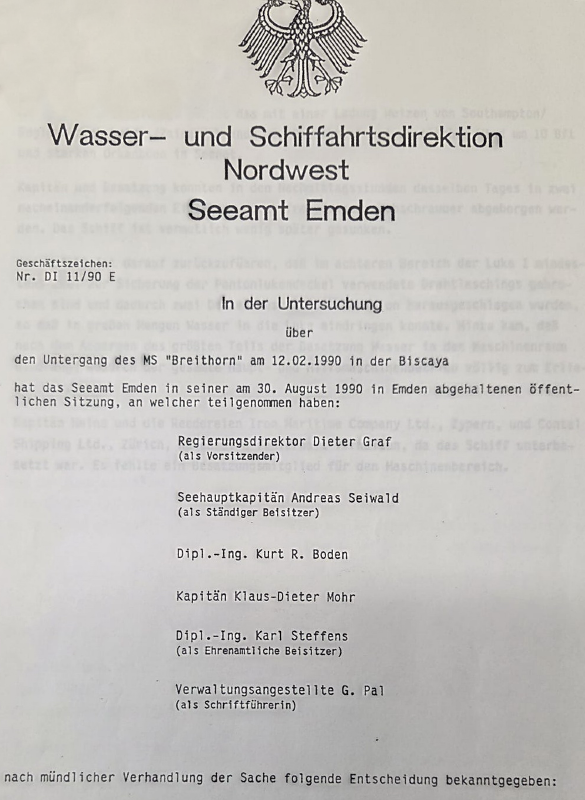
This story is based on an official report from the Emden Maritime Office, which we found in the Federal Archives in Bern. We have significantly shortened the report and omitted many technical, nautical, and meteorological details to make this story more accessible to the average reader. The captain was acquitted of all charges. The court’s only criticism was that the ship was not manned in accordance with the “Safe Manning Certificate” because the third engineer was missing, which, logically, did not cause the BREITHORN to sink. HPS June 2026
Lloyd's List 13. Feb. 1990
|